Showing posts with label Indian Birds. Show all posts

Wednesday, February 19, 2014

Common Hill Myna

The Common Hill Myna (Gracula religiosa), sometimes spelled "mynah" and formerly simply known as Hill Myna, is the myna most commonly seen in aviculture, where it is often simply referred to by the latter two names. It is a member of the starling family (Sturnidae), resident in hill regions of South Asia and Southeast Asia. The Sri Lanka Hill Myna, a former subspecies of G. religiosa, is now generally accepted as a separate species G. ptilogenys. The Enggano Hill Myna (G. enganensis) and Nias Hill Myna (G. robusta) are also widely accepted as specifically distinct, and many authors favor treating the Southern Hill Myna (G. indica) from the Nilgiris and elsewhere in the Western Ghats of India as a separate species.

For more info: http://en.wikipedia.org/wiki/Common_Hill_Myna
 

Common Hoopoe

 
The Hoopoe (Upupa epops) is a colourful bird that is found across Afro-Eurasia, notable for its distinctive 'crown' of feathers. It is the only extant species in the family Upupidae. One insular species, the Saint Helena Hoopoe, is extinct, and the Madagascar subspecies of the Hoopoe is sometimes elevated to a full species. Like the Latin name upupa, the English name is an onomatopoeic form which imitates the cry of the bird.


Greater Coucal


The Greater Coucals or the Crow Pheasants (Centropus sinensis) are non-parasitic cuckoos (unlike other cuckoos, they raise their own chicks). Locally, they are known by numerous names, including: Hindi: Mahoka; Punjabi: Kamadi kukkar; Bengali: Kuka Assamese: Kukoo sorai, Kukuha sorai, Dabahi kukuha; Cachar: Dao di dai; Manipuri: Nongkoubi; Gujarati: Hokko, Ghoyaro, Ghumkiyo; Kutch: Hooka; Marathi: Bharadwaj, Kumbhar kaola, Kukkudkumbha, Sonkawla'; Oriya: Dahuka; Tamil: Kalli kaka, Chembakam; Telugu: Jemudu kaki, Chemara, Mahoka kaki, Samba kaki; Malayalam: Uppan, Chemboth; Kannada: Kembootha; and Sinhalese: Atti kukkula, Bu kukkula.


The Greater Coucal or Crow Pheasant (Centropus sinensis) is a large non-parasitic member of the cuckoo order of birds, the Cuculiformes. A widespread resident in Asia, from India, east to south China and Indonesia, it is divided into several subspecies, some being treated as full species. They are large, crow-like with a long tail and coppery brown wings and found in wide range of habitats from jungle to cultivation and urban gardens. They are weak fliers, and are often seen clambering about in vegetation or walking on the ground as they forage for insects, eggs and nestlings of other birds. They have a familiar deep resonant call which is associated with omens in many parts of its range.

Wednesday, January 1, 2014

BAYA WEAVER


The Baya Weaver (Ploceus philippinus) is a weaverbird found across the Indian Subcontinent and Southeast Asia. Flocks of these birds are found in grasslands, cultivated areas, scrub and secondary growth and they are best known for their hanging retort shaped nests woven from leaves. These nest colonies are usually found on thorny trees or palm fronds and the nests are often built near water or hanging over water where predators cannot reach easily. They are widespread and common within their range but are prone to local, seasonal movements mainly in response to rain and food availability.
 

Description

These are sparrow-sized (15 cm) and in their non-breeding plumage, both males and females resemble female house sparrows. They have a stout conical bill and a short square tail. Non-breeding males and females look alike, dark brown streaked fulvous buff above, plain (unstreaked) whitish fulvous below, eyebrow long and buff coloured, bill is horn coloured and no mask. Breeding males have a bright yellow crown, dark brown mask, blackish brown bill, upper parts are dark brown streaked with yellow, with a yellow breast and cream buff belo.

Behaviour and ecology

Baya Weavers are social and gregarious birds. They forage in flocks for seeds, both on the plants and on the ground. Flocks fly in close formations, often performing complicated manoeuvres. They are known to glean paddy and other grain in harvested fields, and occasionally damage ripening crops and are therefore sometimes considered as pests.They roost in reed-beds bordering waterbodies. They depend on wild grasses such as Guinea Grass (Panicum maximum) as well as crops like rice for both their food (feeding on seedlings in the germination stage as well as on early stages of grain) and nesting material. They also feed on insects (including butterflies), sometimes taking small frogs, geckos] and molluscs, especially to feed their young. Their seasonal movements are governed by food availability. Their calls are a continuous chit-chit-... sometimes ending in a wheezy cheee-eee-ee that is produced by males in a chorus. A lower intensity call is produced in the non-breeding season.

Breeding

The breeding season of the Baya Weavers is during the monsoons. The breeding condition is initiated by environmental characters such as day length and comes to an end after summer although this termination is not influenced by short day length as in temperate birds. They nest in colonies typically of up to 20-30, close to the source of food, nesting material and water. Baya Weavers are best known for the elaborately woven nests constructed by the males.

Flame-throated Bulbul


The Flame-throated Bulbul, (Pycnonotus gularis), is a member of the bulbul family of passerine birds. It is found in southwest India.

Identification
19cm Very short erectile crest Orange-scarlet throat-patch Glossy black head Orange-yellow breast Bright olive tail, rounded, with small whitish corner-tips
Sexes similar
This is a bird of forest and dense scrub. It builds its nest in a bush; two to four eggs is a typical clutch. The Flame-throated Bulbul feeds on fruit and insects. It is virtually crestless, has an orange-red throat and whitish eyes.
Distribution Endemic to south-western India (western Karnataka to Kerala and Tamil Nadu) Locally common .

Taxonomy

 This is a monotypic species. It was formerly included in Black-crested Bulbul.

Habitat

 Evergreen foothill forest, thorny bamboo brakes, lantana thickets

Behaviour
Often seen in small parties in fruiting trees and shrubs with other bulbuls. Usually delivers its slurred song from low branches or telephone wires in bamboo groves and at hill stations.

Breeding
 It builds its nest in a bush; the clutch consisting of 2-4 eggs.

Diet
The diet includes fruit and insects

Monday, November 25, 2013

The White-bellied Sea Eagle (Haliaeetus leucogaster).


The White-bellied Sea Eagle (Haliaeetus leucogaster), also known as the White-breasted Sea Eagle, is a large diurnal bird of prey in the family Accipitridae. Originally described by Johann Friedrich Gmelin in 1788, it is closely related to Sanford's Sea Eagle of the Solomon Islands, and the two are considered a superspecies. A distinctive bird, the adult White-bellied Sea Eagle has a white head, breast, under-wing coverts and tail. The upper parts are grey and the black under-wing flight feathers contrast with the white coverts. The tail is short and wedge-shaped as in all Haliaeetus species. Like many raptors, the female is slightly larger than the male, and can measure up to 90 cm (36 in) long with a wingspan of up to 2.2 m (7 ft), and weigh 4.5 kg (10 lb). Immature birds have brown plumage, which is gradually replaced by white until the age of five or six years. The call is a loud goose-like honking.
Resident from India and Sri Lanka through Southeast Asia to Australia on coasts and major waterways, the White-bellied Sea Eagle breeds and hunts near water, and fish form around half of its diet. Opportunistic, it consumes carrion and a wide variety of animals. Although rated of Least Concern globally, it has declined in parts of southeast Asia such as Thailand, and southeastern Australia. It is ranked as Threatened in Victoria and Vulnerable in South Australia and Tasmania. Human disturbance to its habitat is the main threat, both from direct human activity near nests which impacts on breeding success, and from removal of suitable trees for nesting. The White-bellied Sea Eagle is revered by indigenous people in many parts of Australia, and is the subject of various folk tales throughout its range.


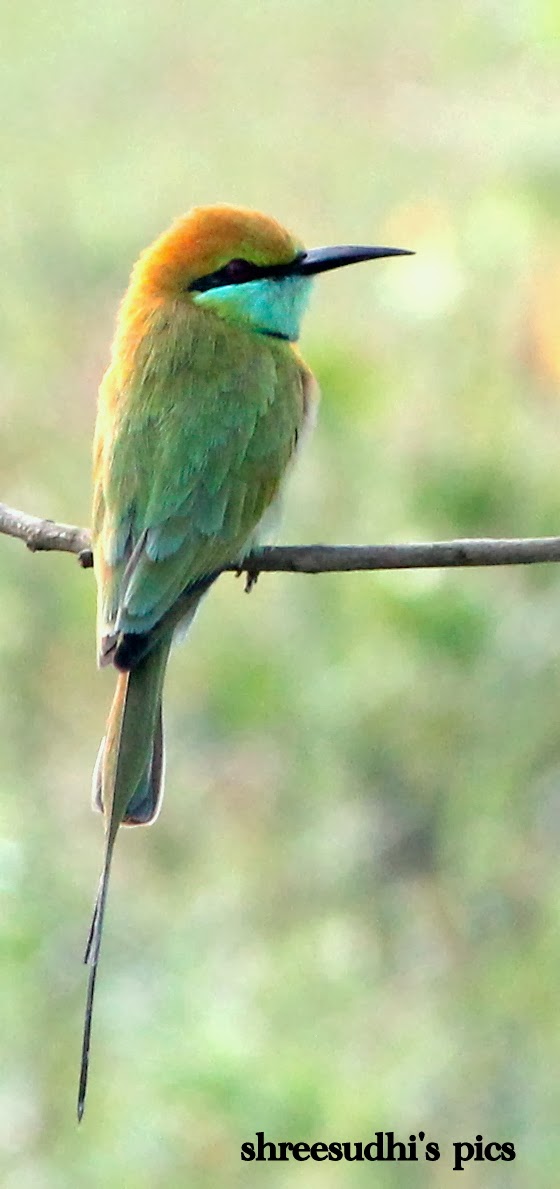
The Green Bee-eater


The Green Bee-eater is a near passerine bird in the bee-eater family. It is resident but prone to seasonal movements and is found widely distributed across sub-Saharan Africa from Senegal and the Gambia

Pale-billed Flowerpecker


Pale-billed Flowerpecker or Tickell's Flowerpecker (Dicaeum erythrorhynchos) is a tiny bird that feeds on nectar and berries, found in India, Bangladesh and Sri Lanka. The bird is common especially in urban gardens with berry bearing trees. They have a rapid chipping call and the pinkish curved beak separates it from other species in the region.


Thursday, November 7, 2013

Eastern Spot-Billed Duck

 
The Spot-billed Duck (Anas poecilorhyncha) also known as the Spotbill, is a dabbling duck which breeds in tropical and eastern Asia. It has three subspecies: the Indian Spot-billed Duck (A. poecilorhyncha poecilorhyncha), Eastern Spot-billed Duck (A. poecilorhyncha zonorhyncha), and Burmese Spot-billed Duck (A. poecilorhyncha haringtoni).
This duck is resident in the southern part of its range from Pakistan and India to southern Japan, but the northern subspecies, the Eastern Spot-billed Duck (A. p. zonorhyncha), is migratory, wintering in Southeast Asia. It is quite gregarious outside the breeding season and forms small flocks. The northernmost populations have expanded their range northwards by more than 500 km since the early 20th century, possibly in reaction to global warming.

Tuesday, September 24, 2013

Ashy Wren-Warbler/or Ashy Prinia

The Ashy Prinia or Ashy Wren-Warbler (Prinia socialis) is a small warbler. This prinia is a resident breeder in the Indian Subcontinent, ranging across most of India, Nepal, Bangladesh, Bhutan, Sri Lanka and western Myanmar. It is a common bird in urban gardens and farmland in many parts of India and its small size, distinctive colours and upright tail make it easy to identify. The northern populations have a rufous rump and back and have a distinct breeding and non-breeding plumage while other populations lack such variation.

Monday, August 12, 2013

River Tern


The Indian River Tern or just River Tern (Sterna aurantia) is a bird in the tern family . It is a resident breeder along inland rivers from Iran east into the Indian Subcontinent and further to Myanmar to Thailand, where it is uncommon. Unlike most Sterna terns, it is almost exclusively found on freshwater, rarely venturing even to tidal creeks.
This species breeds from March to May in colonies in less accessible areas such as sandbanks in rivers. It nests in a ground scrape, often on bare rock or sand, and lays three greenish-grey to buff eggs, which are blotched and streaked with brown.

Indian Robin Male


The Indian Robin (Saxicoloides fulicatus) is a species of bird in the Muscicapidae family. It is widespread in the Indian Subcontinent, and ranges across Bangladesh, Bhutan, India, Nepal, Pakistan, and Sri Lanka. The males of northern populations have a brown back whose extent gradually reduces southwards with populations in the southern peninsula having an all black back. They are commonly found in open scrub areas and often seen running along the ground or perching on low thorny shrubs and rocks. Their long tails are held erect and their chestnut undertail covert and dark body make them easily distinguishable from the Pied Bushchat and the Oriental Magpie Robin.

Thursday, August 1, 2013

Great Tit


The Great Tit (Parus major) is a passerine bird in the tit family Paridae. It is a widespread and common species throughout Europe, the Middle East, Central and Northern Asia, and parts of North Africa in any sort of woodland. It is generally resident, and most Great Tits do not migrate except in extremely harsh winters. Until 2005 this species was lumped with numerous other subspecies. DNA studies have shown these other subspecies to be distinctive from the Great Tit and these have now been separated as two separate species, the Cinereous Tit of southern Asia, and the Japanese Tit of East Asia. The Great Tit remains the most widespread species in the genus Parus.
The Great Tit is a distinctive bird, with a black head and neck, prominent white cheeks, olive upperparts and yellow underparts, with some variation amongst the numerous subspecies. It is predominantly insectivorous in the summer, but will consume a wider range of food items in the winter months, including small hibernating bats. Like all tits it is a cavity nester, usually nesting in a hole in a tree. The female lays around 12 eggs and incubates them alone, although both parents raise the chicks. In most years the pair will raise two broods. The nests may be raided by woodpeckers, squirrels and weasels and infested with fleas, and adults may be hunted by Sparrowhawks. The Great Tit has adapted well to human changes in the environment and is a common and familiar bird in urban parks and gardens. The Great Tit is also an important study species in ornithology.

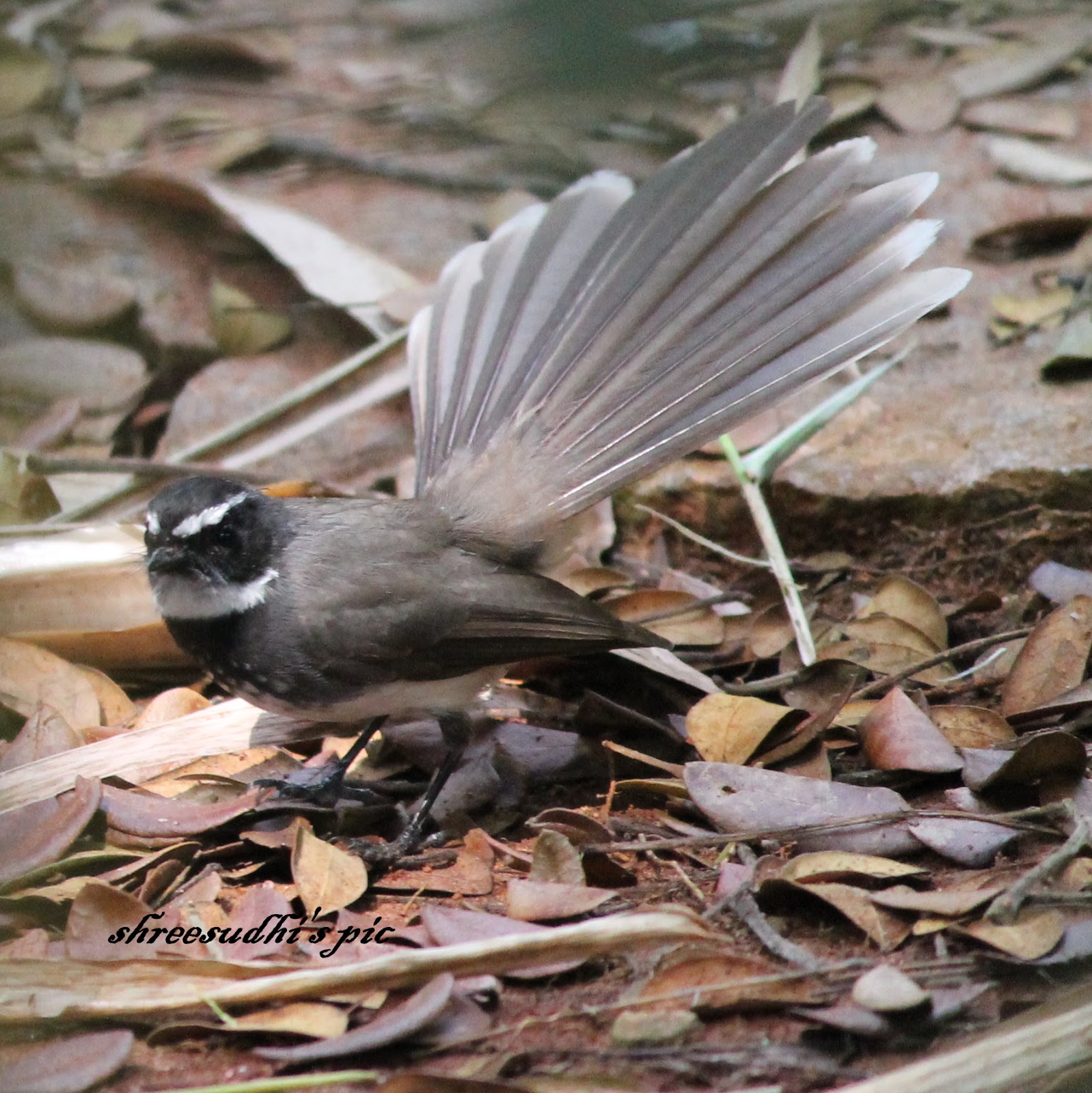
White-spotted Fantail or Spot-breasted Fantail

 
This Picture was taken in Ranganathittu Bird sanctuary, February 2012. When I was coming back after boating, found this cute bird flying here and there and was very curious to know which bird was this. Here are few shots of this beautiful Fantail
 
The White-spotted Fantail or Spot-breasted Fantail (Rhipidura albogularis) is a small passerine bird. It is found in forest, scrub and cultivation in southern and central India. It was formerly considered a subspecies of the White-throated Fantail.

The White-spotted Fantail lays three eggs in a small cup nest in a tree.
The White-spotted Fantail is insectivorous, and often fans its tail as it moves through the undergrowth.
Not normally renowned as a songster, the male uses a fixed and unmistakable pattern of musical notes in its call. The notes are loud and normally divided into two stanzas – the first with 5–6 trilling notes rising and falling, followed by 4–5 notes rising up the scale and ending in the highest note.
Birds use the same song year after year, with progressively small changes, with the result that the song sounds very different after 4–5 years. The male's call is a valuable tool in detection and identification of the bird.


Friday, July 26, 2013

Intermediate Egret

The Intermediate Egret, Median Egret,[2] Smaller Egret[3] or Yellow-billed Egret (Mesophoyx intermedia) is a medium-sized heron. Some taxonomists put the species in the genus Egretta or Ardea. It is a resident breeder from east Africa across the Indian Subcontinent to Southeast Asia and Australia.

Cattle Egret

The Cattle Egret (Bubulcus ibis) is a cosmopolitan species of heron (family Ardeidae) found in the tropics, subtropics and warm temperate zones. It is the only member of the monotypic genus Bubulcus, although some authorities regard its two subspecies as full species, the Western Cattle Egret and the Eastern Cattle Egret. Despite the similarities in plumage to the egrets of the genus Egretta, it is more closely related to the herons of Ardea. Originally native to parts of Asia, Africa and Europe, it has undergone a rapid expansion in its distribution and successfully colonised much of the rest of the world.
It is a white bird adorned with buff plumes in the breeding season. It nests in colonies, usually near bodies of water and often with other wading birds. The nest is a platform of sticks in trees or shrubs. Cattle Egrets exploit drier and open habitats more than other heron species. Their feeding habitats include seasonally inundated grasslands, pastures, farmlands, wetlands and rice paddies. They often accompany cattle or other large mammals, catching insect and small vertebrate prey disturbed by these animals. Some populations of the Cattle Egret are migratory and others show post-breeding dispersal.
The adult Cattle Egret has few predators, but birds or mammals may raid its nests, and chicks may be lost to starvation, calcium deficiency or disturbance from other large birds. This species maintains a special relationship with cattle, which extends to other large grazing mammals. The cattle egret removes ticks and flies from cattle and consumes them. This benefits both species, but it has been implicated in the spread of tick-borne animal diseases.


Feb 2012 Via Shimoga to Bangalore

Thursday, July 25, 2013

Double-crested Cormorant (Phalacrocorax auritus)

 
The Double-crested Cormorant (Phalacrocorax auritus) is a member of the cormorant family of seabirds. It occurs along inland waterways as well as in coastal areas, and is widely distributed across North America, from the Aleutian Islands in Alaska down to Florida and Mexico. Measuring 70–90 cm (28–35 in) in length, it is an all-black bird which gains a small double crest of black and white feathers in breeding season. It has a bare patch of orange-yellow facial skin. Five subspecies are recognized.
The Double-crested Cormorant is found near rivers, lakes and along the coastline. It mainly eats fish and hunts by swimming and diving. Its feathers, like those of all cormorants, are not waterproof and it must spend time drying them out after spending time in the water. Once threatened by use of DDT, the numbers of this bird have increased markedly in recent years.

Spot Billed Pelican/Grey Pelican

 
The Spot-billed Pelican or Grey Pelican is a member of the pelican family. It breeds in southern Asia from southern Pakistan across India east to Indonesia. It is a bird of large inland and coastal waters, especially large lakes.

Scientific name: Pelecanus philippensis
Rank: Species
Higher classification: Pelican

Monday, July 22, 2013

Red-whiskered Bulbul


The Red-whiskered Bulbul (Pycnonotus jocosus) is a passerine bird found in Asia. It is a member of the bulbul family. It is a resident frugivore found mainly in tropical Asia. It has been introduced in many tropical areas of the world where populations have established themselves. It feeds on fruits and small insects and they conspicuously perch on trees and their calls are a loud three or four note call. The distinctive crest and the red-vent and whiskers makes them easy to identify. They are very common in hill forests and urban gardens within its range.